
Goose-stepping troops, armoured vehicles and roaring fighter jets took centre stage in Beijing’s Tiananmen Square, witnessed by a high-profile guest list including Russian President Vladimir Putin and North Korean leader Kim Jong Un.
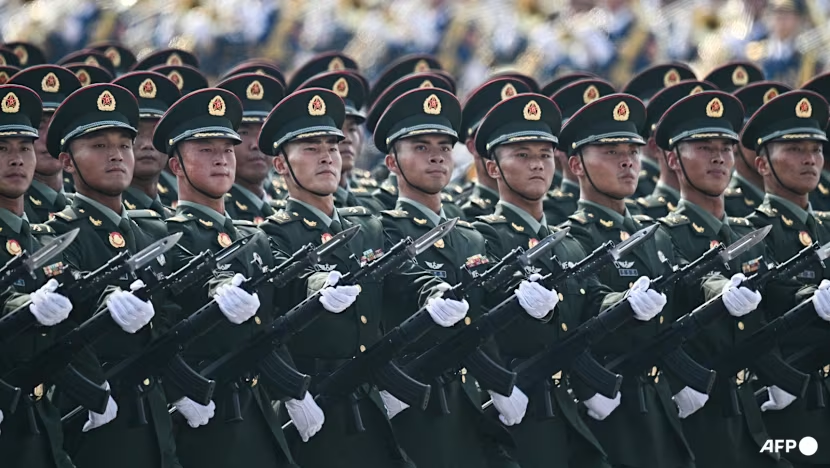
BEIJING: China staged a grand military parade in Beijing on Wednesday (Sep 3) morning to mark the 80th anniversary of the end of World War II, blending martial spectacle with patriotic symbolism.
Columns of marching troops, armoured convoys and fighter jets thundered through and over Tiananmen Square in a meticulously orchestrated display – framed as wartime remembrance, yet equally a projection of China’s military modernisation and national resolve.
An array of foreign leaders was present in a display of China’s convening power, notably Russian President Vladimir Putin and North Korean leader Kim Jong Un, as well as several Southeast Asian figures. Western leaders, however, were largely absent amid deepening geopolitical divides.
Wearing a grey Mao suit, President Xi Jinping presided over the grand ceremony alongside the country’s top leadership, delivering a speech before reviewing the military formations.
Delivering a speech from the Tiananmen rostrum, the Chinese supremo paid tribute to China’s sacrifices, while reaffirming Beijing’s continued determination to safeguard sovereignty and uphold peace.
“Today, humanity once again faces a choice: peace or war, dialogue or confrontation, mutual benefit or zero-sum rivalry,” Xi warned in a speech that lasted for about seven minutes.
His remarks come as wars rage on in Ukraine and the Middle East, while the global order frays under the strain of deepening division and what Beijing sees as Washington’s increasingly unilateralist posture.
Xi said China is committed to the path of peaceful development.
“(We) will work hand in hand with people of all countries to build a community with a shared future for mankind,” he said.
The parade commemorates the 1945 victory over imperial Japan in what China calls the Chinese People’s War of Resistance Against Japanese Aggression and the World Anti-Fascist War.
China was one of the main Allied powers and endured immense suffering during the global conflict, which is estimated to have caused the deaths of between 70 million and 85 million people worldwide.
According to China’s estimates, there were more than 35 million Chinese casualties – both soldiers and civilians – making it one of the bloodiest theatres of World War II.
“History warns us that the destinies of humankind are interlinked,” Xi said in his Wednesday speech.
“Only through treating each other as equals, living in harmony and helping one another can countries and nations maintain collective security, eliminate the roots of war, and prevent the recurrence of historical tragedies.”
The national legislature designated September 3 as “Victory Day” in 2014, making it an official day of remembrance. This was only China’s second Victory Day parade, coming a decade after the first was held in 2015.
The military showcase was the culmination of weeks, if not months, of preparation, with Beijing sealing off central districts for multiple pre-dawn rehearsals, aerial formation drills and convoy run-throughs to ensure a flawless performance.
It featured 45 formations of ground and air forces, alongside displays of “new-generation” equipment that underscore the People’s Liberation Army’s (PLA) modernisation drive.
Defence watchers closely parsed the columns of armour and squadrons of aircraft at the parade – as they have already been doing for the rehearsals – for signals of how far China’s armed forces have come, and where they may be headed next.
Thousands of people sang patriotic songs, soldiers marched in ranks and there was a gun salute.
HIGH-PROFILE GUEST LIST
The Victory Day parade featured a high-profile line-up of foreign guests, underscoring Beijing’s diplomatic reach.
Among the most closely watched attendees were Russia’s Putin and North Korea’s Kim.
Kim and Putin flanked Xi right before the massive parade got underway. In unprecedented scenes, Xi shook both their hands and chatted with the pair as they walked down a red carpet towards Tiananmen Square, with Putin to Xi’s right and Kim to his left.
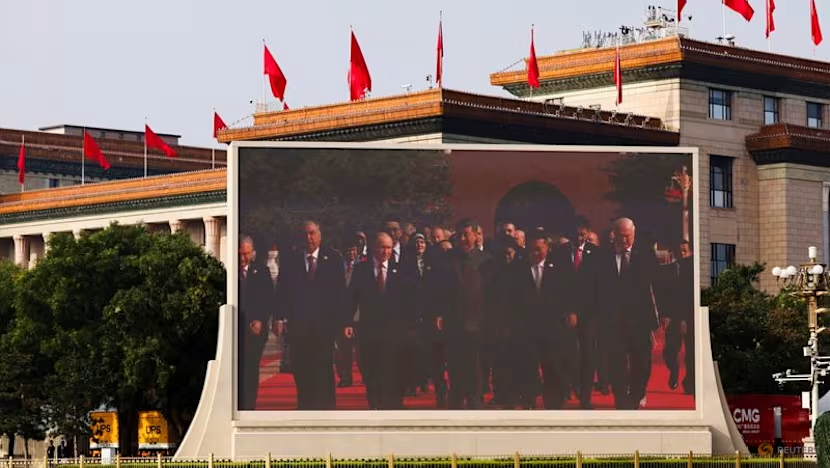
For Putin, his foreign visits have been largely confined to allied or neutral nations amid Western isolation and an International Criminal Court arrest warrant over Russia’s 2022 invasion of Ukraine
As for Kim, it was his first appearance at a major multilateral event since assuming power in 2011, and his first visit to China in more than six years. He did not attend Beijing’s last World War II parade in 2015, sending a senior official instead.
North Korea remains under heavy international sanctions imposed over its nuclear weapons and ballistic missile programmes, though analysts say the measures have lost much of their bite amid growing economic, military and political support from Russia and China.
Western leaders were notably absent, save for Slovakia’s Prime Minister Robert Fico and Serbia’s President Aleksander Vucic.
The guest list also included a raft of Southeast Asian leaders – among them Malaysia’s Prime Minister Anwar Ibrahim, Vietnam’s President Luong Cuong and Singapore’s Deputy Prime Minister Gan Kim Yong – as well as Cambodia’s King Norodom Sihamoni, Lao President Thongloun Sisoulith and Myanmar’s military chief Min Aung Hlaing.
Indonesia’s President Prabowo Subianto is also in attendance for the parade, after earlier cancelling his trip amid anti-government protests at home. He arrived in Beijing early on Wednesday, according to China’s foreign ministry, which said it welcomes the move.
Southeast Asian representation this time around is stronger than at the 2015 parade. A decade ago, attendance from the region was marked by the heads of state from Cambodia, Laos, Myanmar and Vietnam, while Thailand was represented by then-Deputy Prime Minister Prawit Wongsuwan.
Singapore, Malaysia and Indonesia sent special envoys, including former officials or cabinet representatives. Brunei did not feature on published lists of high-level attendees.
The parade comes just days after China hosted the Shanghai Cooperation Organization (SCO) summit in Tianjin, with overlap in the roster of foreign dignitaries attending both events.
That summit saw Xi unveiling a sweeping vision for global governance reform, warning the world was once again at a crossroads as it had been 80 years ago at the founding of the United Nations following World War II.
Source: CNA/ws